Withholding Tax Nigeria: Rates and Compliance Guide 2026

Nigeria's withholding tax (WHT) is an advance payment of income tax deducted at source by the payer on specified transactions before the recipient ever sees the money. Rates vary depending on the transaction type, recipient status as company or individual, and residency, covering a range of applicable percentages. The single most important operational rule: WHT deducted in any calendar month must be remitted to FIRS by the 21st day of the following month. Miss that date and you are looking at a 10% penalty plus interest at the prevailing CBN Monetary Policy Rate.
Here is what you need to know at a glance before diving into the details:
-
Typical rates: 2% (supply of goods, non-manufacturer supplier with qualifying turnover), 5% (consultancy/commission for resident companies), 10% (consultancy/commission for non-resident companies, rent, dividends, interest, royalties), 15% (directors' fees for non-corporate recipients), 20% (winnings for non-corporate recipients)
-
Who deducts: the payer (withholder), not the recipient
-
Who benefits: the recipient receives a WHT credit note or certificate to offset their annual income tax liability
-
Remittance deadline: 21st of the month following deduction
-
Penalty for failure to deduct: up to 40% of the amount not deducted
-
Governing law: Deduction of Tax at Source (Withholding Tax) Regulations 2024, effective January 1, 2025
Table of Contents
- What is withholding tax in Nigeria and what law governs it?
- Current WHT rates in Nigeria: the 2026 reference table
- Who must deduct WHT, and what documents are required?
- How to calculate and remit WHT: worked examples
- Penalties and common compliance mistakes to avoid
- A practical monthly checklist for freelancers and small businesses
- How to handle disputes, refunds, and treaty relief
- Key Takeaways
- Why WHT compliance matters more than most freelancers realize
- Flowna helps you track WHT without the monthly scramble
- Authoritative sources for further reading
What is withholding tax in Nigeria and what law governs it?
WHT in Nigeria is not a standalone tax. It is a collection mechanism: the payer withholds a portion of a payment and remits it to FIRS on behalf of the recipient, who then uses the receipt as a credit against their final income tax bill. Think of it as the government collecting tax early, at the point money changes hands, rather than waiting for annual returns.
The legal foundation is the Deduction of Tax at Source (Withholding) Regulations 2024, gazetted on October 2, 2024 and implemented from January 1, 2025. These Regulations replaced rules that had largely been in place since the 1970s. They apply across four tax statutes: the Companies Income Tax (CIT) Act, the Personal Income Tax (PIT) Act, the Capital Gains Tax (CGT) Act, and the Petroleum Profits Tax (PPT) Act.
"WHT is therefore not an additional tax — it is an advance collection of income or corporate tax. For most recipients, the WHT credit received can be fully offset against their eventual tax liability, making it a timing mechanism rather than a cost (provided you are filing your returns and utilising credits properly)." — Faturoti Taiwo and Co.
Who is required to deduct? The Regulations apply to non-individual bodies, government ministries, departments and agencies (MDAs), statutory bodies, public authorities, and designated payment agents. There is a meaningful small-company carve-out: businesses whose monthly transaction value with a single supplier stays below ₦2,000,000 and whose supplier holds a valid Tax Identification Number (TIN) are exempt from deducting WHT on goods and services. That exemption does not cover rent, dividends, or interest, regardless of transaction size.
WHT is explicitly separate from PAYE. Salary and employment income falls under PAYE. WHT applies to contracts, consultancy, rent, royalties, dividends, interest, winnings, directors' fees, and similar non-salary transactions.
Current WHT rates in Nigeria: the 2026 reference table
The PwC Nigeria tax summary is the most widely cited authoritative reference for current rates. The table below reflects the Deduction of Tax at Source Regulations 2024 as in force for 2026. Always cross-check against the First Schedule for your specific transaction type, and note that double taxation agreements (DTAs) can reduce rates for non-resident recipients.

| Transaction type | Resident corporate | Non-resident corporate | Non-corporate resident | Non-corporate non-resident | |---|---|---|---|---| | Dividends | 10% | 10% | 10% | 10% | | Interest | 10% | 10% | 10% | 10% | | Royalties | 10% | 10% | 10% | 10% | | Rent / lease | 10% | 10% | 10% | 10% | | Consultancy / management / technical fees | 5% | 10% | 5% | 10% | | Commission | 5% | 10% | 5% | 10% | | Construction (gross contract) | — | 10% | — | 10% | | Supply of goods (non-manufacturer, turnover above ₦25m) | 2% | 5% | 2% | 5% | | Directors' fees | 10% | 10% | 15% | 15% | | Winnings (gaming, lottery) | 10% | 10% | 20% | 20% |
A few things worth calling out:
- The 2% rate applies narrowly: supply of goods by a non-manufacturer where the supplier's annual turnover exceeds ₦25 million. Suppliers below that threshold are exempt on goods transactions.
- Consultancy and professional services for resident companies are subject to a clarified rate under the 2024 Regulations, resolving previous uncertainties.
- Non-resident companies generally face 10% across most categories, subject to treaty relief.
- Telephone charges, internet data, and airline tickets are explicitly exempt from WHT under the 2024 Regulations.
DTA note: Where Nigeria has a ratified double taxation agreement with the non-resident's country of residence, the treaty rate may be lower than the domestic schedule rate. The payer must obtain a treaty certificate before applying the reduced rate. Seek professional advice for cross-border payments above routine amounts.
Who must deduct WHT, and what documents are required?
The withholder (the party making the payment) carries the legal obligation to deduct and remit. The recipient has no direct remittance duty, but they carry a different risk: if they do not collect and retain their WHT credit notes, they cannot claim the credit on their annual return and effectively lose money they already paid.
The TIN double-rate rule is one of the most expensive compliance gaps in practice. If a vendor cannot produce a valid TIN at the time of payment, the withholder must apply twice the prescribed WHT rate, capped at 20%. A consultancy payment that would normally attract 5% WHT becomes 10% the moment the vendor's TIN is missing. That extra cost typically falls on the vendor through a reduced net payment, which creates friction and disputes. The fix is simple: collect TINs during supplier onboarding, before any invoice is raised.
Key documents every withholder must produce and retain:
- WHT credit note or certificate issued to the recipient at the time of payment
- Monthly electronic schedule of suppliers (covering TIN, address, nature of transaction, WHT amount deducted, and invoice number)
- Remittance receipts from FIRS for each monthly batch
- Copies of underlying contracts or invoices supporting each deduction
Key documents every recipient (including freelancers) must collect and retain:
- Signed WHT certificate from the payer, matching the invoice amount and deduction
- Copy of the original invoice and payment confirmation
- Any correspondence confirming the amount remitted to FIRS
FIRS Information Circular No. 01/2025 reinforces that detailed supplier schedules and receipts are required to support credit claims. PwC's Nigeria tax summary corroborates the documentation requirements and the double-rate TIN rule.
Pro Tip: Build WHT certificate delivery into your payment acceptance process. Do not release a final invoice as "settled" until the client has issued the WHT certificate. A missing certificate from six months ago is very hard to recover.
How to calculate and remit WHT: worked examples
The formula is straightforward: WHT = Gross payment × Applicable rate. The net amount the recipient receives is the gross minus the WHT. Remittance to FIRS is due by the 21st day of the month following deduction.
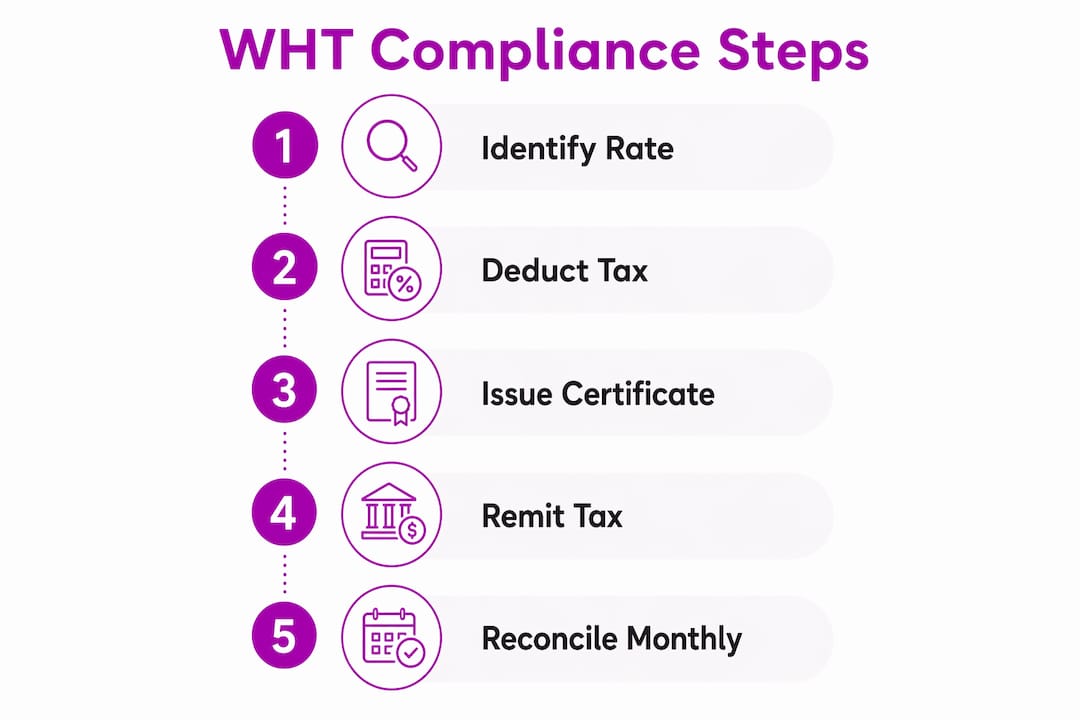
Step-by-step process:
- Identify the transaction type from the First Schedule (consultancy, rent, supply of goods, etc.)
- Determine recipient status: resident or non-resident; corporate or non-corporate
- Confirm the recipient's TIN is valid (double rate applies if not)
- Apply the correct rate to the gross invoice amount
- Withhold the calculated amount and pay the recipient the net
- Issue the WHT credit note to the recipient immediately
- Batch all deductions for the calendar month and remit to FIRS by the 21st of the following month
- File the monthly electronic supplier schedule alongside the remittance
Worked Example 1: Freelancer consultancy fee (5% WHT)
A Lagos-based company hires a freelance consultant and agrees to pay ₦200,000 for a project. The consultant is a resident non-corporate individual.
- Applicable rate: 5% (consultancy, resident)
- WHT deducted: ₦200,000 × 5% = ₦10,000
- Net paid to consultant: ₦190,000
- Company remits ₦10,000 to FIRS by the 21st of the following month
- Consultant receives a WHT certificate for ₦10,000 and claims it as a credit on their annual PIT return
Worked Example 2: Rent payment (10% WHT)
A company pays ₦500,000 monthly rent to a landlord.
- Applicable rate: 10% (rent, resident)
- WHT deducted: ₦500,000 × 10% = ₦50,000
- Net paid to landlord: ₦450,000
- WHT certificate for ₦50,000 issued to landlord; remitted to FIRS by the 21st
Worked Example 3: Supply of goods (2% WHT)
A company purchases office supplies from a non-manufacturer supplier whose annual turnover exceeds ₦25 million, paying ₦300,000.
- Applicable rate: 2% (supply of goods, resident corporate)
- WHT deducted: ₦300,000 × 2% = ₦6,000
- Net paid to supplier: ₦294,000
On batching vs. per-payment records: Operational best practice is to batch the monthly remittance for administrative efficiency while recording WHT on a per-payment basis in your accounting system. Batching reduces the number of FIRS transactions; per-payment records protect you in an audit and allow recipients to match certificates to specific invoices.
One trap worth knowing: contracts above the small-company threshold require WHT deduction on each instalment payment even when individual instalments fall below the exemption threshold. Track contract totals, not just individual payment amounts.
Penalties and common compliance mistakes to avoid
Penalties under the 2024 Regulations are steep enough to make correct compliance the cheaper option by a wide margin.
Headline penalties:
- Failure to deduct WHT: administrative penalty reported at up to 40% of the amount that should have been deducted
- Failure to remit: 10% penalty on the unremitted amount, plus interest at the prevailing CBN Monetary Policy Rate
- Vendor without TIN: double the applicable WHT rate, capped at 20%
The failure-to-deduct penalty is particularly punishing because it falls on the withholder, not the recipient. A company that pays a consultancy fee without deducting the required WHT faces a monetary penalty on top of owing the withheld amount. That is ₦140,000 in exposure from a single missed deduction.
The most common mistakes:
- Applying a flat 2% to every payment regardless of transaction type or recipient status
- Paying vendors without first verifying their TIN, triggering the double-rate exposure
- Issuing WHT certificates late or not at all, leaving recipients unable to claim credits
- Deducting WHT on exempt transactions (telephone charges, internet data, airline tickets, retail purchases without credit invoices)
- Mis-timing deduction on instalment contracts by treating each instalment as independent rather than tracking the total contract value
- Filing nil returns late or not at all (a nil return is required even in months with no WHT deductions)
Pro Tip: Run a monthly reconciliation: total WHT withheld per your accounting records vs. total remitted to FIRS. A one-line spreadsheet check on the 15th of each month gives you six days to catch and fix a gap before the 21st deadline.
A practical monthly checklist for freelancers and small businesses
Freelancers and irregular earners sit on the recipient side of most WHT transactions, which means their main job is collecting certificates and claiming credits, not deducting and remitting. But the controls are just as important. A missing certificate is a missed credit, and missed credits add up fast across a year of project-based income.
Five monthly controls to run every cycle:
- Verify client TIN before the invoice is raised. If the client cannot produce a TIN, flag it before payment, not after.
- Record the transaction type and applicable rate on every invoice entry. Tag it in your records as "WHT withheld at 5%" or whichever rate applies.
- Collect the WHT certificate at the time of payment, not weeks later. Make it a condition of marking the invoice closed.
- Maintain a single monthly WHT ledger showing each invoice, the gross amount, the WHT deducted, the certificate reference, and the client's TIN.
- Reconcile and confirm remittance by the 21st. As a recipient, you cannot remit, but you can confirm with the client that they have remitted and request proof if needed.
Workflow in practice:
You send an invoice for ₦200,000 in consultancy fees. The client pays you ₦190,000 (net after 5% WHT). The client issues a WHT certificate for ₦10,000. You store the certificate alongside the invoice in a folder tagged by month. At year-end, you present all certificates to your tax authority when filing your Personal Income Tax return, and the ₦10,000 (and all other WHT credits accumulated) offset your tax liability.
For small businesses that are also withholders, the same monthly cycle applies on the outgoing side: deduct, issue certificate, batch, remit by the 21st, file the electronic schedule.
Pro Tip: Integrate TIN collection into your client onboarding form alongside your contract and payment terms. Require the WHT certificate as a condition of final payment acceptance, not an afterthought. Chasing certificates from clients six months after a project closes is a losing battle.
How to handle disputes, refunds, and treaty relief
Disputes typically arise in two scenarios: a payer deducts WHT but fails to remit to FIRS, or the recipient and payer disagree on the applicable rate or the amount deducted.
The 2024 Regulations address the first scenario directly. Even where a tax agent (the withholder) fails to remit, the tax beneficiary can still claim WHT credits based on receipts issued by the agent. This is a meaningful protection: you are not penalized for your client's failure to remit, provided you hold the certificate.
Practical dispute resolution steps:
- Collect and retain the WHT certificate from the withholder as your primary evidence
- Request written confirmation from the withholder that the amount was remitted to FIRS (a FIRS remittance receipt or payment reference)
- If the withholder cannot confirm remittance, escalate in writing, citing the Regulations and your right to the credit
- If unresolved, file a formal complaint with FIRS, attaching the WHT certificate, the original invoice, the contract, and all correspondence
- FIRS Information Circular No. 01/2025 provides the procedural framework for these escalations
For non-residents and cross-border payments: Nigeria has ratified double taxation agreements with a number of countries. Where a DTA applies, the treaty rate may be lower than the domestic schedule rate. To access treaty relief, the non-resident must obtain a tax residency certificate from their home country's tax authority and present it to the Nigerian payer before the payment is made. Applying the domestic rate and then seeking a refund is possible but slower and administratively heavier.
Refund claims for excess WHT credits are possible where credits exceed your annual tax liability. In practice, the refund process can be slow. Many tax advisers recommend carrying credits forward rather than applying for a cash refund, unless the amounts are material enough to justify the administrative effort.
Key Takeaways
Nigeria's withholding tax compliance comes down to one repeatable monthly cycle: identify the right rate, deduct at source, issue the certificate, and remit to FIRS by the 21st.
| Point | Details | |---|---| | Rates vary by transaction and recipient | WHT rates include 2% (supply of goods, non-manufacturer supplier with qualifying turnover), 5% (consultancy/commission for resident companies), 10% (consultancy/commission for non-resident companies, rent, dividends, interest, royalties), 15% (directors' fees for non-corporate recipients), and 20% (winnings for non-corporate recipients). | | Remittance deadline is the 21st | WHT deducted in any calendar month must reach FIRS by the 21st day of the following month. | | TIN validation prevents double-rate exposure | A vendor without a valid TIN triggers twice the applicable WHT rate, capped at 20%. | | Certificates are your annual tax credit | Freelancers must collect WHT certificates from every client and present them when filing annual PIT returns. | | Flowna tracks WHT monthly | Flowna lets irregular earners in Nigeria log income, tag WHT deductions, and store credit notes in one place. |
Why WHT compliance matters more than most freelancers realize
The conventional wisdom is that WHT is the client's problem: they deduct, they remit, you just get paid less. That framing is dangerously incomplete.
The WHT certificate your client issues is real money. It represents tax already paid on your behalf, and if you do not collect it, file it, and present it at year-end, you are effectively paying that tax twice. For a freelancer billing ₦3,000,000 a year at a 5% WHT rate, that is ₦150,000 in credits sitting unclaimed. Most freelancers I see struggling with surprise tax bills are not being overtaxed; they are failing to claim credits they already earned.
There is also a cash-flow dimension that the statutory rules do not spell out. When a client deducts WHT and delays issuing the certificate, your net income looks lower than it should until the credit is confirmed. For irregular earners, that gap creates real anxiety. The fix is not to argue about the tax rules; it is to build certificate collection into your payment process so the credit is documented the moment the money moves.
The 2024 Regulations actually made this easier. Clearer rate schedules, a formal small-business exemption, and explicit rules on what is and is not subject to WHT reduce the guesswork. The remaining compliance burden is mostly operational: track the right rate, collect the certificate, store it, and use it. That is a systems problem, not a tax problem.
Flowna helps you track WHT without the monthly scramble
Staying on top of WHT as a freelancer or irregular earner means logging every payment, tagging the WHT rate, storing the certificate, and reconciling before the 21st. Most people do that in a spreadsheet they forget to update, or not at all.

Flowna is built specifically for irregular earners in Nigeria: freelancers, gig workers, traders, and anyone whose income does not arrive on a fixed schedule. You log income in seconds, tag each entry with the applicable WHT rate, and store scanned WHT certificates directly against the invoice. The monthly reconciliation view shows you exactly what has been withheld and what you need to follow up on before the 21st. The AI categorization handles the sorting; you handle the decisions.
This is not a replacement for professional tax advice on complex cross-border transactions or high-value contracts. For those, consult a qualified tax adviser and follow FIRS statutory filing rules. But for the monthly routine of tracking, tagging, and reconciling WHT on everyday project income, Flowna turns a compliance headache into a five-minute monthly check. Start your free 14-day trial at flowna.co and see what a clean WHT record actually looks like.
General information only. Confirm current rates and filing requirements with FIRS or a qualified tax professional for your specific situation.
Authoritative sources for further reading
The table below lists the primary references used in this article. For binding guidance on edge cases, consult FIRS directly. For treaty and high-value transactions, engage a practicing tax adviser.
| Source | What it covers | Notes | |---|---|---| | Deduction of Tax at Source (Withholding) Regulations 2024 — judy.legal | Full text of the 2024 Regulations; transaction lists, rates, exemptions | Primary legal source; effective January 1, 2025 | | FIRS Information Circular No. 01/2025 — Mondaq commentary | Deduction timing, instalment rules, barter/non-cash transactions, dispute procedures | Authoritative FIRS implementation guidance | | PwC Nigeria — Corporate Withholding Taxes | Current rate schedule, TIN double-rate rule, remittance deadline, penalties | Most widely cited practitioner summary | | Pavestones Legal — New WHT Regime | Small-company exemption, credit-claim rules, Regulations overview | Useful for small business and exemption questions | | SmartSMSSolutions — Freelancers and WHT | Freelancer-specific guidance, credit note operations, annual return process | Practical for individual earners | | Andersen Nigeria — Gazette Alert | Gazette publication details, commencement vs. implementation dates, sector impacts | Background on the 2024 reform timeline |