Automate Savings on Irregular Income: A Nigeria Guide

You can reliably automate savings even with unpredictable income. The key is using flexible, rule-based automations tied to what you actually receive, not a fixed calendar date. Start with one rule today: save a modest percentage of each payment you receive, and keep a small spending buffer in your checking account before any transfer goes out.
Automation removes willpower from the equation entirely. It treats savings like a fixed bill you pay yourself first, which is why it works even when income swings week to week. PNC's 2025 guidance reinforces this: small, consistent automations tied to real cash flow beat ambitious fixed-date plans that collapse the moment a slow week hits.
- Save a percentage of each receipt, not a fixed naira amount
- Build a safety buffer before automating anything
- Use incoming-linked rules, not calendar-based transfers
- Review your setup monthly, not just when something goes wrong
Table of Contents
- How do you automate savings when income is irregular?
- Which automation methods actually work for variable pay?
- How do you prevent overdrafts when automating savings?
- When should you review and adjust your automations?
- What does it cost and how long before you see results?
- Which account features actually help you automate savings?
- Four copyable automation templates for irregular earners
- Key Takeaways
- Why automation is the right move for irregular earners
- Flowna makes this easier to set up in Nigeria
- Sources and further reading
How do you automate savings when income is irregular?
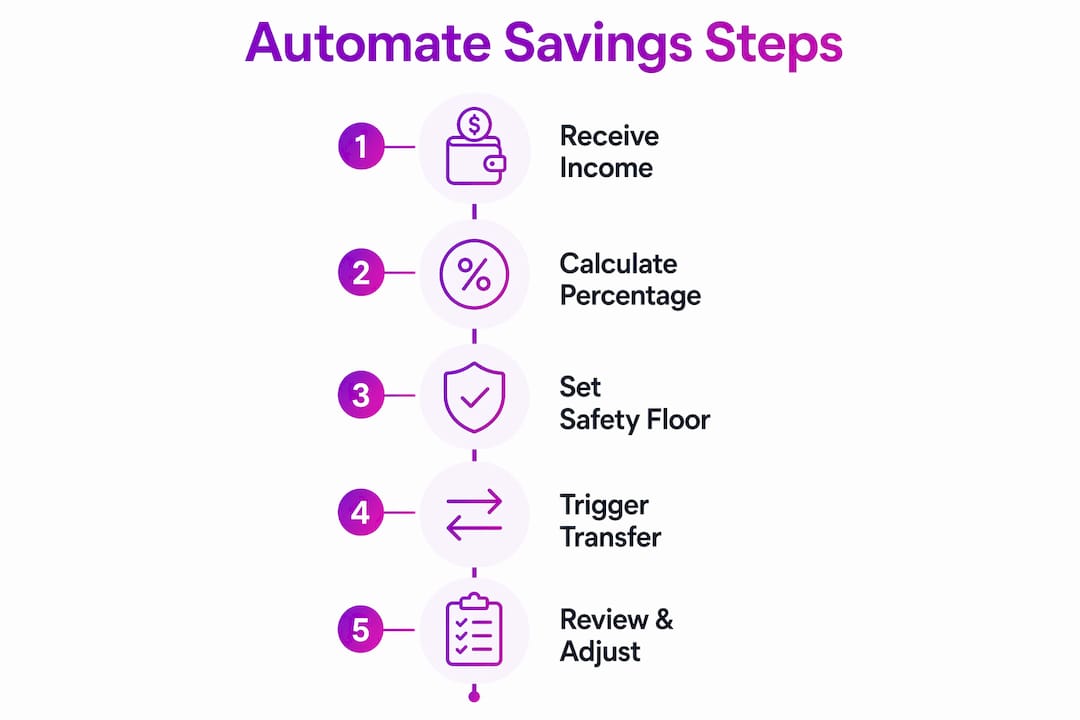
The fastest setup takes about five minutes and three decisions: where the money goes, how much, and what protects you from overdrafts.
- Open a dedicated savings pot or sub-account. Keep it separate from your spending account. The psychological distance alone reduces impulsive withdrawals.
- Set a small percent-of-pay rule. Start at 5–10% of each incoming payment. If your bank or app supports it, use a direct-deposit split or a rule triggered by incoming credits rather than a scheduled date.
- Define your safety floor. Calculate 7 days of essential expenses (food, transport, data). That number is your minimum checking balance. No transfer goes out if your balance is below it.
- Schedule the transfer immediately after typical receipt arrival. If you usually receive payments on Mondays, set the sweep for Monday evening. Timing it right after income lands reduces the chance of an empty account.
- Set a low-balance alert. Most banking apps let you trigger a notification when your balance drops below a threshold. Set it at 1.5× your safety floor so you get a warning before the floor is breached.
Pro Tip: If your bank supports it, use a direct-deposit split rather than a scheduled transfer. The money routes to savings before it ever hits your spending account, which means you never see it and are far less tempted to spend it.
Which automation methods actually work for variable pay?
Not all automation rules are equal for irregular earners. Rules tied to incoming amounts or balance thresholds outperform fixed-date transfers because they scale automatically with your cash flow.
Percent-of-pay rule Save a fixed percentage of every payment received. At 10%, a ₦5,000 receipt saves ₦500; a ₦50,000 receipt saves ₦5,000. No math required after setup. Start at 5% if cash is tight, move to 15% during strong months.

Buffer-first sweep Set a minimum checking balance (your safety floor). Any amount above 2× that floor gets swept to savings. If your floor is ₦10,000 and your balance hits ₦25,000, the sweep moves ₦5,000 to savings and leaves ₦20,000 in place.
Windfall rule For large or one-off payments, automatically move 20–30% to a goal account before spending any of it. A ₦100,000 project payment? ₦25,000 goes straight to savings, the rest funds operations.
- Percent-of-pay: best for daily or weekly receipts
- Buffer-first sweep: best for traders with lumpy daily cash
- Windfall rule: best for freelancers with occasional large invoices
- Repurposing freed-up money: cancel a subscription and automate that exact amount to savings instead
Pro Tip: Prefer rules tied to incoming amounts or balance thresholds over fixed-date transfers. A fixed-date rule on the 15th of the month fails the moment a slow week pushes your balance low. An incoming-linked rule only fires when money actually arrives.
How do you prevent overdrafts when automating savings?
Automation without guardrails can hurt you faster than no automation at all. Investopedia warns that set-it-and-forget-it plans leave some earners short during low-income months, triggering NSF fees that wipe out small savings gains.
Calculate your safety floor first. Add up 7–14 days of non-negotiable expenses: food, transport, data, rent installments. That total is your floor. No automated transfer should fire when your balance sits below it.
Pause triggers to set up now:
- Two consecutive weeks of below-average income
- Any NSF or overdraft fee appearing on your statement
- A major unexpected expense (medical, vehicle repair)
- Balance dropping below 1.5× your daily spending average
Enroll in your bank's low-balance alert and set it above your safety floor, not at zero. An alert at ₦5,000 when your floor is ₦8,000 gives you time to pause the automation before a fee hits — not after.
Enroll in overdraft protection if your bank offers it, but treat it as a last resort, not a substitute for a proper floor. Some accounts charge per-use fees for overdraft coverage that can exceed the amount you were trying to save.
Pro Tip: Run a small daily buffer alongside your main safety floor. Keep ₦1,000–₦2,000 as a daily cushion above the floor. Combined with a monthly review, this cuts false positives where your automation fires on a day your balance dips temporarily.
When should you review and adjust your automations?
Weekly (5 minutes): Confirm transfers cleared. Check for any fees. Note whether your balance stayed above the safety floor all week.
Monthly (15 minutes):
- Review total saved vs. target
- Check for any NSF or overdraft fees
- Update your safety floor if expenses changed
- Adjust your savings percentage up or down based on the past month's income average
- Confirm your goal account is growing
Quarterly stress test: Experian recommends a quarterly review for anyone whose income fluctuates more than 10–15%. Model a 30–60 day low-income scenario. If your buffer would run out, lower your automated percentage and extend your review cadence until the buffer rebuilds.
Concrete triggers that mean adjust now, not next month: two or more low-income weeks in a row, a consistent overdraft warning, or a major one-off expense that depleted your buffer.
What does it cost and how long before you see results?
Common costs to watch: transfer fees (some Nigerian banks charge ₦10–₦52 per transfer), potential NSF fees if your floor is set too low, and account maintenance fees on secondary savings accounts. Small fees compound quickly against micro-savings, so confirm your bank's fee schedule before setting up.
Timeline examples:
- Saving 5% of ₦20,000/week in receipts = ₦1,000/week = ₦4,000/month
- Saving a moderate percentage of monthly total receipts
- A starter emergency fund can be built in a few months with consistent monthly savings
What counts as real progress:
- Every automated transfer clears without triggering a fee
- Your safety floor stays intact for 4+ consecutive weeks
- Ad-hoc borrowing from friends or family drops
- Your goal account shows visible growth after 60 days
- You reach a 7–14 day operational buffer
Progress is not just the balance. A month where every transfer cleared and no fees hit is a win, even if the amount saved was small.
Which account features actually help you automate savings?
Banks and apps commonly offer direct-deposit splits, scheduled transfers, and round-up features. Choosing the right combination depends on your income pattern.
Features worth using:
- Sub-accounts or savings pots: separate buckets for different goals
- Sweep rules: auto-move funds when balance exceeds a threshold
- Direct-deposit splits: route income to savings before it hits spending
- Round-up tools: save the spare change on every transaction
- High-yield savings accounts: HYSAs in early 2026 were offering interest rates in the 4–5% APY range, significantly better than standard savings accounts.
| Method | Pros | Cons | |---|---|---| | Pot/sinking fund | Goal clarity, psychological barrier | Manual top-up if no sweep | | Sweep-on-balance | Scales with cash flow, avoids overdraft | Requires balance monitoring | | Percent-of-pay | Simple math, automatic scaling | Needs incoming-credit trigger support | | Round-up | Painless, builds habit | Very slow accumulation alone |
Transfer delays of 1–2 days between accounts are actually useful. That friction slows impulsive withdrawals without blocking genuine emergencies.
Four copyable automation templates for irregular earners
-
Freelancer (irregular invoices): Save 10% of every invoice payment immediately on receipt. For larger payments, apply a windfall rule: move a substantial portion to a goal account before using the rest. Review monthly.
-
Rideshare driver (daily/weekly pay): Calculate your daily safe-spend (weekly income ÷ 7). Keep a moderate spending buffer. Any day your balance exceeds 1.5× that buffer, sweep the excess to savings that evening.
-
Market trader (high-volume days): On your best trading days, split large-day receipts: 70% to operations, 30% to savings. Keep a reasonable floor amount. On slow days, pause the automation entirely.
-
Seasonal worker (long income gaps): Build a larger buffer covering 30 days of expenses before automating anything. Save at a lower rate during the active season. Run a monthly stress test during off-season to confirm the buffer holds.
Pro Tip: Run any new template at half the intended percentage for the first month. If no overdrafts occur and the buffer stays intact, scale up to the full rate in month two.
Key Takeaways
Automating savings on irregular income works when rules are tied to incoming amounts and protected by a safety floor, not fixed to calendar dates.
| Point | Details | |---|---| | Start with percent-of-pay | Save 5–10% of each receipt; scale up during strong months. | | Set a safety floor first | Calculate 7–14 days of essential expenses; no transfer fires below that balance. | | Use incoming-linked rules | Sweeps tied to balance thresholds or incoming credits outperform fixed-date transfers. | | Review on a cadence | Weekly check, monthly balance review, quarterly stress test if income swings significantly. | | Flowna for local implementation | Flowna's daily safe-spend limit and goal-based automation are built for Nigerian irregular earners. |
Why automation is the right move for irregular earners
Most financial advice assumes a salary. Fixed-date transfers on the 25th of the month make sense when you know money will be there. For a freelancer waiting on three invoices, a driver whose weekly take varies by ₦15,000, or a trader whose best day funds the next two weeks, that advice is practically useless.
What actually works is removing the decision entirely. When savings happen automatically at the moment income arrives, you never have to choose between saving and spending. The choice is already made. That is what the behavioral research behind automation consistently shows: willpower is finite, and irregular earners burn through it faster than anyone because every week brings a new financial calculation.
The local realities matter too. Cash incomes, bank transfer delays, and fee structures in Nigeria mean that a template built for a US salaried worker will fail here. Safety floors need to account for transfer timing. Fee traps are real at small savings amounts. And the psychological weight of financial uncertainty is heavier when income is genuinely unpredictable, not just variable by a few percent. Flowna's daily safe-spend approach was built around exactly these conditions: give irregular earners one clear number to work with each day, and let the automation handle the rest.
Flowna makes this easier to set up in Nigeria
Irregular earners in Nigeria need tools built for their reality, not adapted from somewhere else. Flowna gives you a daily safe-spend number calculated from your actual income and expenses, so you always know what you can spend today without wrecking tomorrow.

Goal-based automation inside Flowna lets you set percent-of-receipt rules and savings targets without spreadsheets or manual calculations. Log income in seconds via voice, photo, or SMS. The AI categorization handles the bookkeeping so you can focus on earning. There is a 14-day free trial with no commitment required. Try Flowna and set up your first automated savings rule today.
Sources and further reading
- How to Create an Automatic Savings Plan — Experian
- Automatic Savings Plan: What it Means, How it Works — Investopedia
- Automatic Savings: Benefits & Strategies — PNC Insights
- How to Set Up Automatic Savings (Pay Yourself First) — Finance Pulse
- A Guide to Setting Up Automatic Savings — Chase
- Automation methods and best practices — Ayotek
- Experian guidance on financial reviews
Stat to know: According to Finance Pulse, automation removes the willpower variable from saving entirely, treating it like a fixed bill rather than a discretionary choice — the single biggest reason consistent savers outperform inconsistent ones over time.
This article is general financial information, not professional advice. Confirm current fees, account terms, and transfer rules with your bank or a qualified financial professional before setting up any automated plan.