Goal Based Savings: Set Monthly Targets and Automate Them

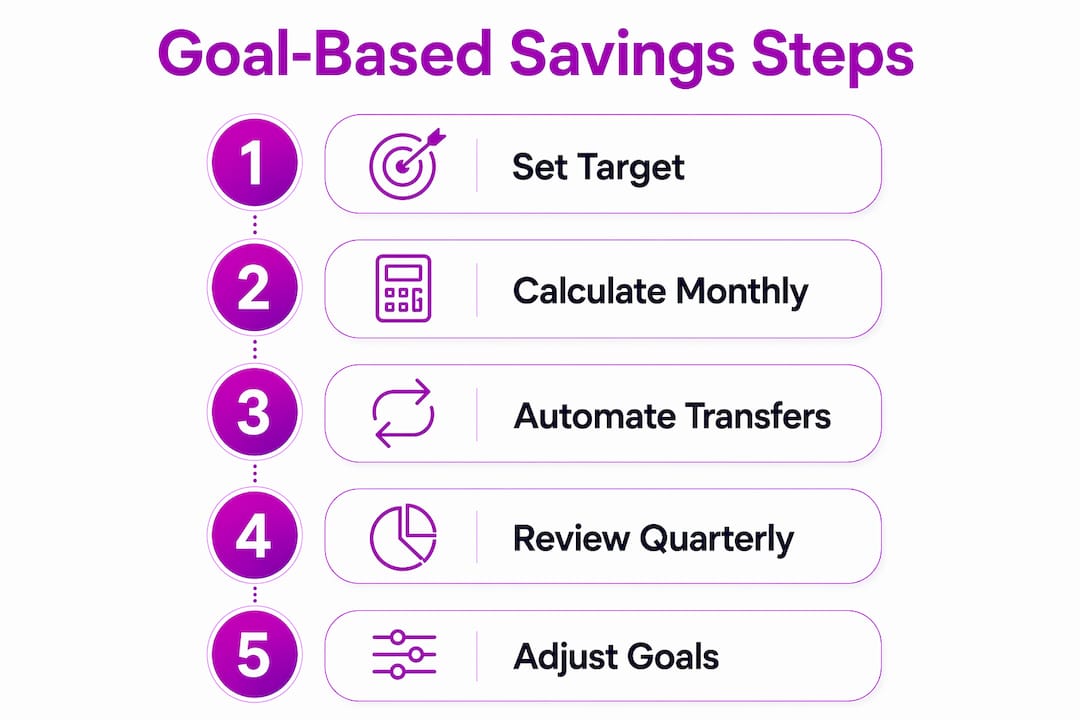
Goal-based savings means assigning every dollar you save to a specific, named purpose with a deadline and a monthly contribution attached. Instead of watching a single balance grow with no clear destination, you build separate buckets, each tied to a real goal. Getting started takes three steps:
- Define your goal: Name it, price it, and set a deadline (e.g., "$6,000 vacation fund by December").
- Calculate your monthly contribution: Divide the total amount by the number of months remaining.
- Automate the transfer: Schedule a recurring deposit on payday so the decision never falls to willpower.
Before you do anything else, run your numbers through the Investor.gov Savings Goal Calculator, a free tool from the U.S. Securities and Exchange Commission that factors in your starting balance, timeline, and expected return to give you a precise monthly target.
Table of Contents
- What does goal-based savings actually mean?
- Why goal-based savings works better than generic saving
- How to build a goal-based savings plan step by step
- How to use a savings goal calculator
- How to stay on track and treat goals as living documents
- Common savings goals, timelines, and where to keep the money
- Which tools and features should you prioritize?
- Key Takeaways
- Why the automation part matters more than the math
- Useful sources for further reading
- Flowna puts goal-based savings on autopilot for irregular earners
What does goal-based savings actually mean?
Generic saving looks like this: income arrives, you spend what you spend, and whatever is left drifts into a single account labeled "savings." There is no deadline, no target, and no way to know whether you are on track. Goal-based saving flips that. Each goal gets its own name, dollar amount, and end date before a single dollar moves.
The difference shows up fast in practice. A "general fund" account tells you nothing about whether you can afford a trip next summer. A bucket labeled "Maui trip — $4,200 — August" tells you exactly where you stand every time you log in. Fidelity recommends pinning down the goal, timeline, and amount together because those three inputs also determine which account type makes sense, whether a high-yield savings account, a CD, or a brokerage account.
Goals are timebound and measurable by design. That specificity is what separates a wish from a plan.
Why goal-based savings works better than generic saving
The biggest reason people abandon budgets is that budgets feel like restrictions. Goal-based saving reframes money as a tool for specific outcomes rather than a set of rules to follow. That shift in framing changes behavior in ways that generic saving cannot.
People with written financial goals are more than twice as likely to stick to a budget compared to those without written goals. Writing a goal down converts a vague intention into a commitment. Seeing a named bucket fill up over time provides the kind of visual progress that keeps motivation alive between paydays.
There are also practical financial advantages. When you know a goal is 18 months away, you know to keep those funds liquid and safe rather than exposed to market swings. When you have three competing goals, the method forces you to rank them, which means you make deliberate trade-offs instead of spending on whatever feels urgent that week. Prioritization becomes automatic once every dollar has a destination.
How to build a goal-based savings plan step by step
This is where most guides go vague. Here is the actual sequence.
-
Define the goal precisely. Name it, estimate the total cost, set a hard deadline, and rank it against your other goals. "Save money" is not a goal. "$10,000 home down payment by January 2028" is.
-
Calculate your monthly contribution. The formula is straightforward: target amount ÷ number of months remaining = required monthly contribution. For a $10,000 goal 12 months away with no starting balance, that is $10,000 ÷ 12 = roughly $833 per month. If you already have $2,000 saved, the remaining $8,000 ÷ 12 = about $667 per month.
-
Fit the contribution into your budget. Most people need to find the money somewhere. Common sources: cancel subscriptions you rarely use, redirect a completed loan payment, round up daily purchases to the nearest dollar, or treat any windfall (tax refund, bonus, freelance payment) as goal fuel rather than spending money. Goal-based budgeting pairs well with a zero-sum structure, where every dollar of income gets assigned a job before the month begins.
-
Choose the right vehicle. For goals under two years, keep funds in a high-yield savings account or a short-term CD where principal is protected. For goals five or more years out, a brokerage account with a conservative allocation makes sense. Do not put a 6-month emergency fund in stocks.
-
Name your buckets and separate them. Many banks let you open multiple savings accounts at no cost. Label each one after its goal. Separation prevents the money from blending into a general pool and getting spent.
Pro Tip: Treat your savings contribution like a recurring bill. Schedule the transfer for the same day your paycheck lands. Automated savers contribute up to roughly 40% more annually than manual savers, because the decision never competes with other spending.
A practical priority sequence worth following: build a small emergency buffer of $1,000–$2,500 first, then capture any employer retirement match, then eliminate high-interest debt, then build a full three-to-six-month emergency fund, then fund other goals in ranked order.

How to use a savings goal calculator
A calculator removes the guesswork from the monthly math. The Investor.gov Savings Goal Calculator is the most trustworthy free option available, built and maintained by the SEC. It asks for four inputs:
- Goal amount: the total you need to reach
- Timeline: how many months or years you have
- Starting balance: what you already have saved toward this goal
- Expected annual return: the interest rate or investment return you anticipate
For the expected return, be conservative. A high-yield savings account in 2026 may offer somewhere in the 4–5% range, but rates change. For a goal you need to hit in under two years, use a low rate or even 0% to stress-test the plan. For a 10-year retirement goal, a moderate historical equity return assumption is reasonable, but Vanguard guidance is clear: match the vehicle to the horizon, not to wishful return assumptions.
Using the $10,000 in 12 months example from the previous section, with a $2,000 starting balance and a 4.5% annual return, the calculator will confirm a monthly contribution slightly below $667 because interest does a small amount of work. The difference is modest at short timescales, which is exactly why short-term goals should not rely on return assumptions to close a funding gap.
How to stay on track and treat goals as living documents
The most useful mental shift in goal-based saving is changing the question you ask before a purchase. Instead of "can I afford this?" ask "which goal does this delay?" That reframe, backed by behavioral research, reduces decision fatigue because it ties every spending choice to a concrete trade-off rather than an abstract budget line.
Practical tactics that actually hold:
- Automate on payday. Set transfers to fire the same day income arrives. Once the money moves, it is no longer available for impulse spending.
- Use separate accounts for each goal. Mixing funds in one account is how goals quietly get raided.
- Round up purchases. Many banks and apps offer round-up features that sweep spare change into a designated goal account.
- Treat windfalls as goal fuel. Tax refunds, bonuses, and side income are the fastest way to compress a timeline.
- Redirect completed goals immediately. When a goal is funded, point that automation at the next priority before the money gets absorbed into spending.
For irregular income earners, the approach needs one adjustment: base your monthly contribution on a conservative rolling average of recent income rather than your best month. Build the emergency buffer first, and treat any month above average as an opportunity to accelerate a goal.
Pro Tip: Schedule a 15-minute quarterly review. Check each bucket's progress, adjust contributions if income has changed, and close out any goal you have completed. Fidelity and other major advisory firms treat goals as living documents, not fixed contracts.
Common savings goals, timelines, and where to keep the money
| Goal | Suggested timeline | Recommended vehicle | |---|---|---| | Emergency fund (starter) | 3–6 months | High-yield savings account (FDIC-insured) | | Emergency fund (full, 3–6 months of expenses) | 6–18 months | High-yield savings account (FDIC-insured) | | Vacation or large purchase | 6–18 months | High-yield savings account or short-term CD | | Home down payment | 2–5 years | High-yield savings, CDs, or conservative bond funds | | Education (529 plan) | 5–18 years | 529 plan or brokerage with age-based allocation | | Retirement | 10 years or more | 401(k), IRA, or brokerage with diversified allocation |
The one-sentence rule of thumb: use cash or liquid accounts for goals under roughly two years, a conservative mix for two-to-five-year goals, and market exposure for anything five years or beyond. Vanguard's guidance on matching time horizon to vehicle is the clearest articulation of this principle available for free.
Which tools and features should you prioritize?
The Investor.gov Savings Goal Calculator is the right starting point for any new goal. It is neutral, free, and built by the SEC, which means no upsell and no data harvesting. Use it to establish your monthly target before you open any account.
When comparing banks and apps for automating your plan, look for these features:
- Multiple named savings buckets within one account (avoids the need to open many separate accounts)
- Scheduled recurring transfers that fire on a specific date each month
- FDIC insurance on all short-term goal accounts (non-negotiable for money you cannot afford to lose)
- Round-up tools that sweep spare change automatically
- Low or no fees on savings accounts, since fees directly reduce your effective return
- Tax-advantaged accounts for retirement (401(k), IRA) and education (529) goals where applicable
Avoid keeping short-term goal money in investment accounts. The risk of a market dip wiping out a year of progress on a vacation fund is not worth any potential return.
Key Takeaways
Goal-based savings works because it converts vague intentions into named, timebound buckets with automated monthly contributions, removing willpower from the equation entirely.
| Point | Details | |---|---| | Write goals down | People with written goals are more than twice as likely to stick to a budget. | | Use the monthly formula | Divide your target amount by months remaining to get your required monthly contribution. | | Automate on payday | Automated savers contribute up to roughly 40% more annually than manual savers. | | Match vehicle to timeline | Use cash accounts for goals under two years; market exposure for goals five years or beyond. | | Flowna for irregular earners | Flowna's goal-based savings automation and daily Safe-Spend metric help variable-income earners stay on track without manual math. |
Why the automation part matters more than the math
Most articles on goal-oriented savings plans spend too much time on the formula and not enough on the behavior. The math is simple. The hard part is keeping the money in the bucket when rent is due, a car needs a repair, or income drops for a month.
What actually works is removing the decision entirely. When a transfer fires automatically on payday, the money is gone before you can rationalize spending it. That is not a trick; it is how the psychology of saving actually functions. The goal-based framing adds a second layer: when you can see a named bucket filling up, you have a concrete reason to leave it alone. A bar labeled "Maui trip: 67% funded" is harder to raid than a number sitting in a general account.
The quarterly review matters for a different reason. Goals change. Income changes. A goal you set in January may need a new timeline by April, and that is fine. Treating a savings plan as a living document rather than a fixed commitment is what separates people who eventually hit their goals from those who abandon the plan after the first setback.
Useful sources for further reading
- Investor.gov Savings Goal Calculator — Free SEC-maintained calculator; enter your goal, timeline, and starting balance to get a precise monthly target.
- Fidelity: How to set and reach savings goals — Practical guidance on matching account types to goal timelines and adjusting plans as circumstances change.
- Vanguard: How to set and achieve your savings goals — Clear framework for matching savings vehicles to time horizons, from cash accounts to long-term investment allocations.
- mymoney.gov — U.S. government financial literacy hub covering budgeting, saving, and planning tools for consumers.
- FinancialToolset: Goal-Based Savings Planner — Interactive planner with a priority waterfall to help sequence multiple goals.
Flowna puts goal-based savings on autopilot for irregular earners
Budgeting apps built for salaried workers assume the same paycheck every two weeks. That assumption breaks down fast for freelancers, gig workers, traders, and anyone whose income varies month to month. Flowna is built specifically for that reality.

Where most apps give you a static budget, Flowna gives you a daily Safe-Spend number that recalculates as your income changes, so you always know exactly how much you can spend today without derailing a goal. Goal-based savings automation is built in: name a goal, set a target, and Flowna handles the contribution logic around your actual cash flow rather than an assumed salary. Add AI-powered expense categorization, voice and photo transaction logging, and tax-aware tracking, and you have a tool that does the heavy lifting most irregular earners currently do in their heads.
The free 14-day trial gives you full access to every feature. Start your trial at Flowna and set up your first automated goal bucket today.